

Long-term alpha
Retirement fund planner
Plan today for a retirement corpus that can support regular withdrawals later.
Know how much to save and invest to live comfortably after work.
Start a SIP from ₹500, invest with every fund house, and see every folio in one place — with our MF desk a phone call away when it matters.
Pick the one closest to your reason. We explain the kind of fund it leads to, then list every one available through Labdhi — with today’s NAV. No jargon needed.
Funds that own established companies, or a whole index such as the Nifty 50. Their value will rise and fall — sometimes sharply — so give them five years or more.
Finding funds…
Every fund here is available through Labdhi. NAVs are end-of-day from the fund houses. Sorted by name, not by return — this is a list to explore, not a recommendation. Read the scheme documents before investing.
A mutual fund is a pool of professionally managed money. An Asset Management Company collects money from investors who share a common objective and invests it across equities, debt, bonds, gold or other instruments. You hold units, and the profit or loss is shared in proportion to the units you hold.
Minimum SIP amounts are set by each scheme, not by us — most start at ₹500 or ₹1,000. Mutual funds in India are regulated by SEBI and AMFI. Labdhi distributes them as an AMFI-registered distributor, ARN-78991.
Before choosing equity, hybrid, liquid or multi-asset funds, answer a short risk questionnaire and use the result as the starting point for allocation.
Mutual Fund investments are subject to market risks, read all scheme related documents carefully.
Each fund charges a yearly expense ratio within SEBI’s limits. It is already taken out of the NAV — you never pay it separately. In the regular plans we distribute, part of that expense ratio is our commission as an AMFI-registered distributor (ARN-78991); there is no separate fee from us. Some schemes charge an exit load if you redeem early, as set out in the scheme document.
See the full tariffSign up using your PAN, Aadhaar and basic details.
Verified online — one KYC covers every fund house on the platform.
Browse and select based on your goal and risk profile, or ask our MF desk for a shortlist.
Decide how much to invest each month, and pick your SIP date.
Confirm the mandate and track the investment as it grows.

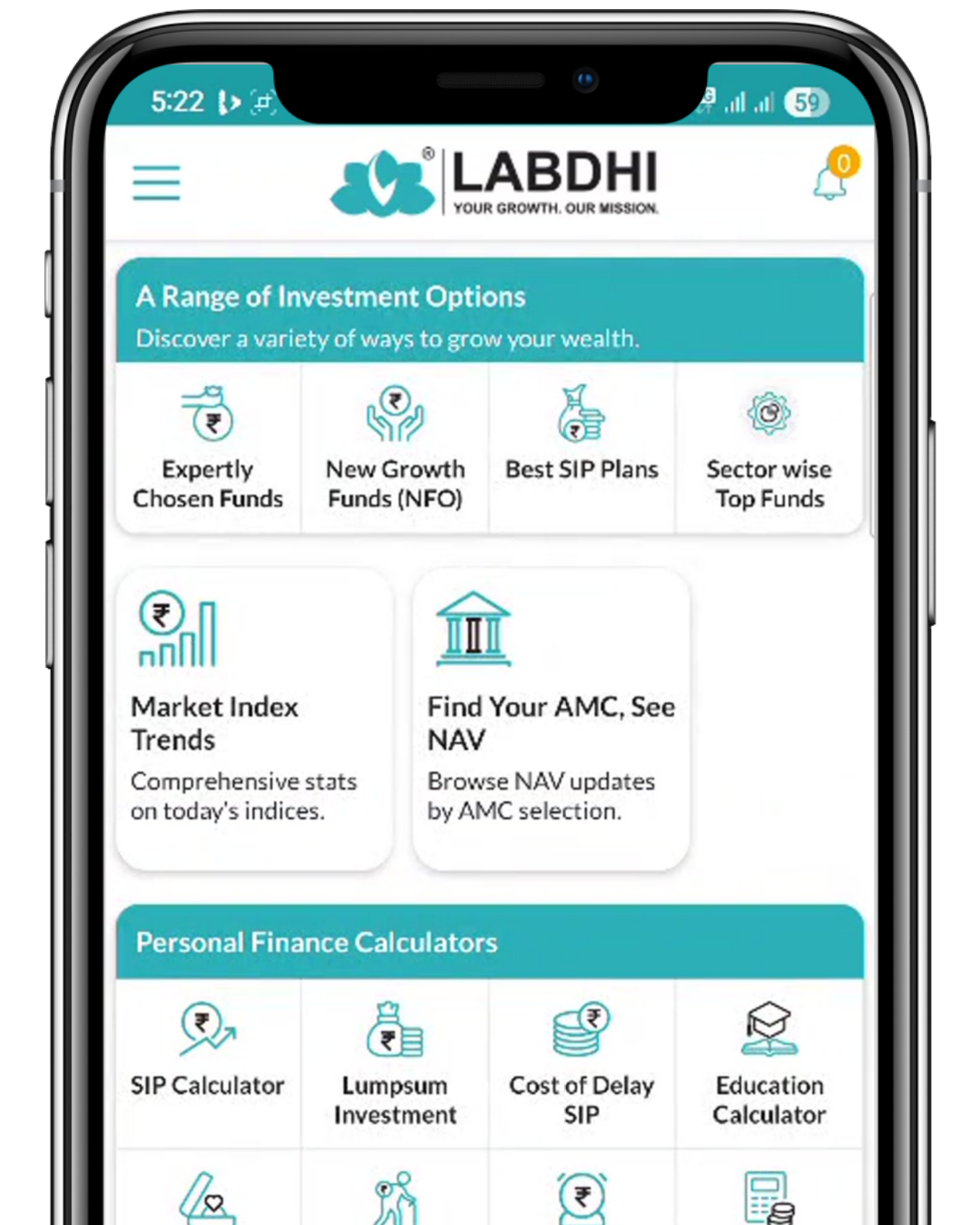
A dedicated app for investors who aren’t traders. No tickers flashing, no order book — just your funds, your SIPs and your goals, in a view your family can actually read.
Share your goal, time horizon and current folios. Our MF desk can shortlist categories that match your risk profile and show what to start, pause, step up or transfer.
This is help from our distribution desk on regular plans. Independent, fee-based advice is a separate service — see Advisory.
Use this only to size the habit. Scheme selection and actual transactions happen in the Labdhi MF app after suitability checks.
Open the full SIP calculator →Illustration only; not a scheme return, guarantee or recommendation. Actual NAV movement can be negative.
Six statements. Decide whether each is a myth or a fact, and the card turns over to tell you why.
“Many funds let you start a SIP with ₹500 a month.”
“A fund with a lower NAV is cheaper.”
“Index funds are low risk.”
“A SIP protects you from losses.”
“An open-ended fund can be redeemed on any business day.”
“IDCW is extra income on top of my returns.”
Goals, the categories and what each is for, the five ways money goes in and out, and everything the app does.
Search schemes, choose SIP or lumpsum, then see how available NAV observations translate into a simple investor path.
Start with what the money is for, then match the time horizon and risk level before choosing the fund category.
Plan today for a retirement corpus that can support regular withdrawals later.
Know how much to save and invest to live comfortably after work.
Prepare for rising education costs without making the whole plan depend on one market cycle.
Match the fund mix to the year the money will actually be needed.
Create a dedicated pool for a large family goal instead of dipping into long-term investments.
Use a more conservative mix as the date comes closer.
Turn travel goals into a short-term plan with liquidity and risk kept in view.
Avoid using equity-heavy funds for money you need soon.
Build the down-payment corpus separately, with enough flexibility for changing dates and costs.
Blend growth and safety depending on how far away the purchase is.
Keep a reserve available for surprises without disturbing the rest of the portfolio.
Prioritise access and stability over chasing returns.
Use category, horizon and risk fit to shortlist funds before investing inside the Labdhi MF app.
Invest in stocks with growth potential to build long-term wealth.
Balance growth and stability by investing in a mix of equity and debt.
Earn steadier returns through debt investments; prices still move with interest rates.
Track an index through low-cost funds — they move as much as the index does.
Funds built around a goal — retirement or a child’s future — with a 5-year lock-in.
Keep money accessible, usually with a short wait to redeem.
Spread across equity, debt, commodities and more.
Risk is set fund by fund: every scheme carries SEBI’s six-level riskometer, shown on its own page. Equity and index funds usually sit at the top of it.
The scheme you pick matters less than most people think. How you put money in, and take it out, matters more.
A single large amount invested into a scheme all at once.
A fixed amount invested at a fixed interval, usually monthly.
A lump sum parked in a safer fund, then transferred into equity in fixed instalments.
A fixed amount withdrawn from your investment at a regular interval.
Units moved from one scheme to another within the same fund house.
From profile set-up to the statements your CA asks for at tax time.
Keep personal details, bank accounts and nominee information ready for investing.
Discover funds and shortlist options around risk, horizon and goal.
Estimate SIP, lumpsum and goal values before placing the transaction.
Follow SIPs, current values and folio movements without opening a trading screen.
Start, pause, step up or stop SIPs from the app.
Allocation, growth and current holdings across fund houses in one place.
Purchases, redemptions, switches and systematic transactions, clearly listed.
Capital gains and tax-season statements when you need them.
A mutual fund is a pool of professionally managed money. Asset Management Companies collect money from investors sharing a common investment objective and invest it across equities, debt, bonds, gold and other instruments. You hold units representing your share of the pool.
The fund collects money from many investors and invests it in a diversified portfolio. Investors are allotted units, and the returns — profit or loss — are shared in proportion to the units held.
Mutual funds in India are regulated by SEBI, with AMFI as the industry body, together providing the transparency and investor-protection framework.
There is no perfect time. Starting early through a SIP averages your cost and reduces the risk of getting the timing wrong, which is the risk most people actually run.
NAV is the per-unit market value of a scheme’s assets minus its liabilities. It is what your units are worth on a given day.
A New Fund Offer is the launch of a new scheme by an AMC, offered at an initial price while it collects money from investors.
Funds that invest in a single industry — IT, pharma, banking. Concentrated in one sector, so both the risk and the potential return are higher than a diversified fund.
A Systematic Withdrawal Plan lets you withdraw a fixed amount at regular intervals from an existing investment, producing a monthly or quarterly income from a corpus you have already built.
By combining disciplined investing with a Systematic Transfer Plan. You invest a lump sum in a relatively safer fund — debt or hybrid — and transfer a fixed amount into equity funds over time. That reduces timing risk, gives you rupee-cost averaging, and keeps you participating in long-term equity growth. Over a long enough period, staying invested and letting compounding work is what turns a corpus into something that can be passed on.
Mutual funds are subject to market risk and their value fluctuates with market conditions. No return is assured, and the risk differs sharply between an equity fund and a liquid fund.
We are an AMFI-registered distributor (ARN-78991) and place investments in regular plans, on which the fund house pays us a trail commission. That commission is disclosed and pays for the platform, the reviews and the servicing you receive. If you prefer direct plans, you can invest with the fund house yourself. Fee-based investment advice is a separate service under our SEBI investment adviser registration, kept apart from distribution — see Advisory.
There is no separate fee charged by us for mutual fund transactions. The fund’s own expense ratio applies, from which the AMC pays our trail commission. Exit loads, stamp duty and taxes are set by the fund and the government, not by us.
Yes. Existing folios can be mapped to your Labdhi account through a change-of-broker process without redeeming and repurchasing, so there is no tax event. Ask us and we will handle the paperwork.
Most funds allow a SIP from ₹500 a month and lumpsum from ₹1,000, though the exact minimum is set by each scheme.
Equity funds held over a year are taxed as long-term capital gains, with gains up to ₹1.25 lakh a year exempt; shorter holdings are taxed as short-term. Debt fund gains are added to your income and taxed at slab rate. Rules change — confirm the current position with your tax adviser.
No. Your money goes directly from your bank account to the fund house, and units are held in your name with the AMC or in your demat account. We facilitate the transaction and service the folio.
Mutual fund investments are subject to market risks. Read all scheme related documents carefully before investing. Past performance is not indicative of future returns and no return is assured or guaranteed. Labdhi is an AMFI-registered mutual fund distributor (ARN-78991) and earns a trail commission from the fund house on regular plans; we do not charge you a separate fee for mutual fund transactions.
Open a free Labdhi account, finish KYC on your phone, and set up your first SIP today.